
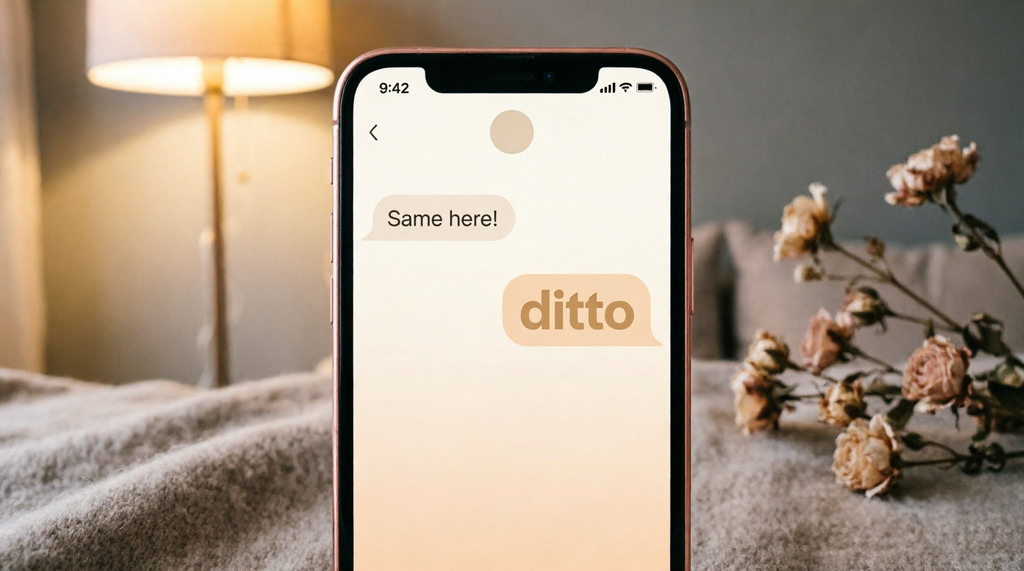
If someone texts you Ditto they usually mean same here I agree or I feel the same way. It is a quick way to say that the previous message also applies to you, without repeating everything the other person just said.
You may see ditto in text messages group chats comments, social media posts and casual online conversations. Unlike many internet abbreviations, it is not really new slang. The word has been used in English for a long time but texting has made it an easy and convenient response.
For example if your friend says I’m exhausted today you could simply reply Ditto.You are saying I’m exhausted too.
Understanding the context is important because the tone can change slightly. Depending on the conversation ditto can sound friendly funny casual enthusiastic or even a little dry.
What Does “Ditto” Mean in a Text?

In texting, ditto means that you feel, think, or experience the same thing as the person who just spoke.
It can replace phrases such as:
- “Same.”
- “Me too.”
- “I agree.”
- “I feel the same.”
- “Same here.”
- “I was thinking the same thing.”
- “That applies to me too.”
The simplest definition is:
Ditto = the same thing applies to me.
Imagine that your friend sends:
“I really need a vacation.”
You respond:
“Ditto.”
Your message means:
“I really need a vacation too.”
You do not have to repeat the entire sentence. The single word communicates the shared feeling.
This makes “ditto” especially useful in casual conversations where both people already understand what is being discussed.
Is “Ditto” Slang?
Not exactly.
“Ditto” is better described as a casual expression than modern internet slang. It has been part of English vocabulary for centuries.
That distinction matters because someone who uses “ditto” is not necessarily trying to sound trendy or use social-media slang. The word existed long before smartphones, texting apps, TikTok, Instagram, or Snapchat.
Today, however, it fits naturally into digital communication because texting often favors short responses.
Instead of typing:
“I completely agree with you, and I feel exactly the same way.”
Someone can simply write:
“Ditto.”
It saves time while still communicating the basic idea.
Where Did the Word “Ditto” Come From?
The history of “ditto” is surprisingly interesting.
The word comes from Italian, where detto means “said” or “stated.” It entered English use through commercial and written contexts, where people needed a quick way to indicate that something was the same as what had already been written.
Over time, “ditto” became associated with repetition or sameness.
For example, in an old list, if several items had the same information as the line above, “ditto” could be used instead of writing the same information again.
That original idea is still present when people use the word in messages today.
When you text “Ditto,” you are essentially saying:
“The thing you just said applies to me as well.”
The modern texting meaning is therefore closely connected to the word’s traditional meaning.
Why Do People Say “Ditto” Instead of “Same”?
Both words can communicate a similar idea, but they have slightly different personalities.
“Same” is extremely common in modern online conversations. It often feels very casual and direct.
“Ditto” can sound a little more playful, expressive, or old-fashioned.
Compare these:
Friend: “I could sleep for twelve hours.”
You: “Same.”
Or:
Friend: “I could sleep for twelve hours.”
You: “Ditto.”
Both responses mean that you also want a lot of sleep.
The difference is mostly in tone.
“Same” feels like everyday internet language. “Ditto” may feel more deliberate, humorous, or slightly quirky.
What Does Ditto Mean When Someone Replies to You?
When someone responds to your message with “ditto,” they are generally agreeing with you or saying that your statement describes them as well.
For example:
You: “I’m nervous about tomorrow.”
Them: “Ditto.”
They mean:
“I’m nervous about tomorrow too.”
Another example:
You: “This is my favorite restaurant.”
Them: “Ditto.”
That means:
“It’s my favorite restaurant too.”
The word usually refers directly to something you have just said.
Because of this, you normally understand “ditto” by looking at the previous message.
Examples of “Ditto” in Text Messages
Seeing realistic examples is one of the easiest ways to understand how the expression works.
Example 1: Sharing an Emotion
Alex: “I’m so tired today.”
Sam: “Ditto.”
Here, Sam means:
“I’m tired too.”
Example 2: Agreeing With an Opinion
Mia: “That movie was much better than I expected.”
Noah: “Ditto.”
Noah is agreeing with Mia’s opinion.
Example 3: Sharing a Plan
Friend: “I’m staying home tonight.”
You: “Ditto.”
You are saying:
“I’m staying home tonight too.”
Example 4: Sharing a Preference
Friend: “I love spicy food.”
You: “Ditto!”
This means you also love spicy food.
Example 5: Agreeing With a Complaint
Friend: “Mondays are way too long.”
You: “Ditto.”
You are saying you feel the same way.
Example 6: Showing Support
Friend: “I hope everything works out.”
You: “Ditto.”
In this context, the word can mean:
“I hope that too.”
The exact meaning comes from the sentence before it.
What Does “Ditto” Mean on Social Media?
On social media, “ditto” generally carries the same basic meaning: “same,” “I agree,” or “I feel that way too.”
Someone might use it in a comment beneath a post.
For example, a person posts:
“I need a break from social media.”
Someone comments:
“Ditto.”
The commenter is saying they feel the same.
It can also appear in discussions:
User 1: “This is one of the best books I’ve read this year.”
User 2: “Ditto.”
Here, the second person agrees with the first person’s assessment.
Because social media comments are often short, a single word can sometimes communicate a complete response.
What Does Ditto Mean on Snapchat?
On Snapchat, “ditto” can simply mean “me too” or “same here.”
For example:
“I’m bored.”
“Ditto.”
is saying:
“I’m bored too.”
It can also be used in response to opinions, plans, feelings, or experiences.
The platform itself does not give the word a special meaning. Its interpretation comes from ordinary English usage and the context of the conversation.
What Does Ditto Mean on Instagram?
On Instagram, the meaning is usually just as straightforward.
Suppose someone comments:
“I want to visit this place someday.”
Another person might reply:
“Ditto!”
That means:
“I want to visit it someday too.”
You might also see it under posts about food, travel, entertainment, relationships, work, school, or everyday life.
The expression is flexible because it refers back to whatever statement came immediately before it.
What Does Ditto Mean on TikTok?
TikTok users may use “ditto” in comments when they strongly relate to something in a video.
For example, a creator posts:
“When you finally get home and don’t want to talk to anyone.”
A commenter might write:
“Ditto 😂”
The person is saying:
“That describes me too.”
The emoji can add extra emotion or humor.
“Ditto” itself does not have a special TikTok-only definition. It simply works as a short agreement or shared-experience response.
Does Ditto Mean “I Agree”?
Sometimes, yes.
But “ditto” is slightly broader than “I agree.”
“I agree” usually means you accept or support someone’s opinion.
“Ditto” can mean agreement, but it can also mean that you share a feeling, situation, preference, desire, or experience.
For example:
“I’m freezing.”
A response of “Ditto” does not necessarily mean you agree with an opinion. It means:
“I’m freezing too.”
Similarly:
“I want pizza.”
“Ditto.”
This means:
“I want pizza too.”
So, “ditto” is better understood as “the same applies to me.”
Does Ditto Mean “Me Too”?
Yes, in many texting situations.
“Me too” is probably the closest everyday translation of “ditto.”
Consider:
“I’m excited for the weekend.”
“Ditto.”
This can be rewritten as:
“I’m excited for the weekend too.”
Or simply:
“Me too.”
There is no major difference in the basic message.
The main distinction is tone. “Ditto” may sound a little more playful or distinctive than “me too.”
Does Ditto Always Show Agreement?
No.
This is an important detail.
Sometimes “ditto” indicates shared circumstances rather than agreement with an opinion.
For example:
“I haven’t slept much this week.”
“Ditto.”
Person B is not agreeing with a claim. They are saying they have also experienced the same thing.
Likewise:
Person A: “I have three assignments due tomorrow.”
Person B: “Ditto.”
The second person is saying they also have three assignments due.
So the underlying idea is sameness, not necessarily agreement.
Can “Ditto” Sound Sarcastic?
Yes, depending on the situation.
Like many short expressions, “ditto” can take on a different tone depending on punctuation, surrounding words, and the relationship between the people talking.
For example:
“Oh, you’re annoyed? Ditto.”
This could be completely friendly.
But:
“You think you’re the only one who’s tired? Ditto.”
could sound irritated or sarcastic.
The word itself is not inherently sarcastic. The surrounding context determines the tone.
If you’re unsure how someone intended it, look at the rest of the conversation.
What Does “Ditto!” With an Exclamation Mark Mean?
An exclamation mark can make the response sound more enthusiastic.
Compare:
“Ditto.”
with:
“Ditto!”
The first can feel neutral or understated.
The second can sound more energetic, playful, or emphatic.
For example:
Friend: “I can’t wait for our trip!”
You: “Ditto!”
That feels enthusiastic.
By contrast:
Friend: “I’m exhausted.”
You: “Ditto.”
The period makes it sound calmer and more matter-of-fact.
These are subtle differences, but punctuation can influence how short messages are interpreted.
What Does “Ditto” Mean From a Guy?
If a guy texts you “ditto,” the basic meaning does not automatically change because of his gender.
He is usually saying “same,” “me too,” or “I feel the same way.”
For example:
You: “I really enjoyed talking to you.”
Him: “Ditto.”
In that situation, he is saying he also enjoyed the conversation.
However, whether the message has a romantic meaning depends on the larger conversation. The word itself does not automatically indicate flirting.
You should consider what was said before it, your relationship with the person, and any other signals in the conversation.
What Does “Ditto” Mean From a Girl?
The same principle applies if a girl sends “ditto.”
She may simply mean:
“Same here.”
For example:
You: “I’m looking forward to seeing you.”
Her: “Ditto.”
That means she is also looking forward to seeing you.
It may be friendly, romantic, or completely casual depending on the circumstances.
The word alone is not enough to determine someone’s intentions.
Does “Ditto” Mean Someone Likes You?
Not necessarily.
This is one of the biggest mistakes people make when interpreting short text responses.
If someone replies “ditto” after you say something affectionate, they may be returning the same feeling. But the word itself is not a secret romantic code.
For example:
You: “I miss hanging out with you.”
Them: “Ditto.”
They are saying they also miss hanging out with you.
That could be meaningful, but it does not automatically tell you whether they are romantically interested.
Look at the complete conversation instead of assigning a special meaning to one word.
How to Reply When Someone Says “Ditto”
Your response depends on what they were agreeing with.
If the conversation is casual, you can simply continue naturally.
For example:
You: “I’m exhausted.”
Them: “Ditto.”
You could say:
“This week has been brutal.”
Or:
“We both need a day off.”
If the conversation is funny, you can respond playfully:
“At least we’re suffering together 😂.”
If the person is agreeing with a preference, you can continue the topic:
“Then we definitely need to try that restaurant.”
There is no special response required.
“Ditto” is simply part of the conversation.
Can You Use “Ditto” by Itself?
Yes.
In fact, using it alone is very common.
For example:
“I need coffee.”
“Ditto.”
The previous message provides all the context needed.
However, if the conversation has moved through several different topics, “ditto” may become unclear.
For example:
“I love that song.”
“I went to the store.”
“Ditto.”
Now it is difficult to know what “ditto” refers to.
Good communication depends on context.
When Should You Avoid Using “Ditto”?
Although the word is perfectly normal in casual conversation, it may not be the best choice in every situation.
Formal Emails
In a formal workplace email, it is usually clearer to write:
“I agree.”
or:
“I feel the same way.”
“Ditto” can sound too casual depending on the professional setting.
Serious Conversations
If someone is sharing something emotional or sensitive, replying only with “ditto” may seem dismissive.
For example:
“I’ve been having a really difficult week.”
A response of:
“Ditto.”
might technically mean you are also struggling, but it does not offer much emotional support.
A warmer response could be:
“I understand. I’ve been having a difficult week too. I hope things get easier for you.”
The right response depends on the situation.
Ditto vs. Same
These two expressions overlap heavily.
| Expression | Basic meaning | Typical tone |
|---|---|---|
| Ditto | The same applies to me | Casual, playful |
| Same | I feel the same | Very casual, modern |
| Me too | I also feel/do this | Friendly, straightforward |
| I agree | I share your opinion | Neutral to formal |
| Same here | I have the same experience | Casual |
| I feel the same | My feelings match yours | More personal |
If you’re texting friends, any of these can work in the right context.
“Same” is often the shortest and most internet-native option, while “ditto” has a slightly more distinctive feel.
Ditto vs. Me Too
“Ditto” and “me too” can often be used interchangeably.
Consider:
“I love this song.”
“Me too.”
“Ditto.”
Both responses communicate the same basic idea.
The difference is stylistic rather than grammatical.
“Me too” sounds extremely natural in everyday speech.
“Ditto” can sound more playful, concise, or slightly old-fashioned.
Ditto vs. I Agree
These expressions are related but not identical.
“I agree” specifically focuses on agreement.
“Ditto” focuses on sameness.
For example:
“I think this restaurant is overpriced.”
“I agree.”
This clearly means you share the opinion.
You could also say:
“Ditto.”
That works because your view is the same.
But:
“I’m hungry.”
“I agree.”
sounds unusual.
“Ditto.”
works perfectly because you’re saying you are hungry too.
Ditto in Group Chats
“Ditto” can be especially useful in group conversations.
Imagine several friends are discussing weekend plans:
A: “I vote for pizza.”
B: “Ditto.”
C: “Same.”
D: “I’m in.”
Everyone is expressing support for the same idea without repeating the entire sentence.
In a large group chat, however, it can sometimes be unclear which message someone is responding to. Quoting or directly replying to a message can make the meaning clearer.
Why Short Responses Like “Ditto” Work So Well in Texting
Text conversations have their own communication style.
People often do not want to type complete sentences when a short response will do the job.
Words such as:
- “Same”
- “Exactly”
- “Yep”
- “True”
- “Agreed”
- “Ditto”
- “Absolutely”
allow people to respond quickly.
“Ditto” is useful because it refers backward. Instead of creating a new sentence, it points to the previous statement and says that it applies again.
This is one reason the word fits naturally into messaging.
Does Ditto Have a Negative Meaning?
Usually, no.
“Ditto” is generally neutral or positive.
However, tone can change its meaning.
A sarcastic:
“Ditto.”
could sound dismissive.
A cheerful:
“Ditto!”
could sound enthusiastic.
A simple:
“Ditto.”
may simply be neutral agreement.
If someone sends the word without emojis or additional context, do not automatically assume they are being rude.
Is “Ditto” Rude in Texting?
Generally, no.
It is a normal casual response.
However, the appropriateness depends on what the other person said.
If someone sends a long, thoughtful message and you respond only with “ditto,” they might feel that you did not give their message enough attention.
For quick statements, though, it is completely natural.
For example:
“I’m tired.”
“Ditto.”
No problem.
But if someone writes several paragraphs about a difficult personal experience, a one-word response could feel insensitive.
The issue is not the word itself. It is whether the response matches the emotional weight of the conversation.
Can “Ditto” Be Used in Spoken Conversation?
Yes.
Although people often encounter the word in writing, “ditto” can also be spoken.
For example:
Person A: “I could really use a vacation.”
Person B: “Ditto.”
This is perfectly understandable.
The spoken version may sometimes sound humorous or slightly old-fashioned, depending on the speaker.
That can actually be part of its charm.
Common Situations Where People Use “Ditto”
You may see this expression when people share:
Feelings
“I’m nervous about the exam.”
“Ditto.”
Preferences
“I prefer tea over coffee.”
“Ditto.”
Opinions
“That was the best part of the movie.”
“Ditto.”
Experiences
“I’ve been stuck in traffic all morning.”
“Ditto.”
Plans
“I’m staying home tonight.”
“Ditto.”
Desires
“I want to travel more.”
“Ditto.”
Reactions
“That was hilarious!”
“Ditto!”
In every case, the basic concept is the same: the second person is saying that the previous statement applies to them too.
Common Misunderstandings About “Ditto”
Because it is such a short word, people sometimes overinterpret it.
It doesn’t automatically mean “I love you.”
If someone responds “ditto” to an affectionate message, they may be returning the sentiment, but context matters.
It isn’t exclusively internet slang.
The word predates modern social media by a very long time.
Sarcasm comes from context and tone, not from the word itself.
It doesn’t require a special response.
You can simply continue the conversation normally.
How to Understand “Ditto” Without Confusion
When you receive this word, look at the message immediately before it.
Ask yourself:
What exactly could the other person be saying is the same?
For example:
“I’m really excited for the concert.”
“Ditto” = “I’m excited too.”
“I don’t understand this homework.”
“Ditto” = “I don’t understand it either.”
“That was a terrible idea.”
“Ditto” = “I agree; I also think it was a terrible idea.”
“I have work tomorrow.”
“Ditto” = “I have work tomorrow too.”
The surrounding context normally makes the intended meaning obvious.
Frequently Asked Questions:
What does ditto mean in a text message?
It usually means “same,” “me too,” or “the same applies to me.” The person is saying that they share the feeling, opinion, experience, preference, or situation mentioned in the previous message.
Is ditto a positive word?
It is generally neutral. Depending on context, it can sound friendly, enthusiastic, humorous, or occasionally sarcastic.
Is ditto the same as “same”?
In many texting situations, yes. Both can mean that you feel or think the same way.
Is ditto formal English?
It is a standard English word, but it is usually more natural in casual conversation than in highly formal writing.
Does ditto mean “I agree”?
Sometimes. If the previous message expresses an opinion, “ditto” can mean “I agree.” But it can also mean “me too” when talking about feelings or experiences.
Can I reply “ditto” to a friend?
Yes. It is perfectly normal in casual conversations.
What does ditto mean after “I miss you”?
It generally means “I miss you too.” However, the emotional or romantic significance depends on the overall relationship and conversation.
Does ditto mean someone is flirting?
Not by itself. It simply indicates that the person shares what was just said. Other parts of the conversation would be needed to determine whether flirting is involved.
Why do people use ditto instead of repeating themselves?
Because it is short and convenient. It lets someone communicate that the previous statement applies to them without repeating the entire sentence.
Is ditto still used today?
Yes. Although it is not one of the newest forms of internet slang, people still use it in texts, chats, comments, and everyday conversation.
Final Takeaway:
So what does ditto mean in a text?
In most cases, it simply means same me too or I feel the same way. It tells the other person that their previous statement also applies to you.
The word is not limited to texting or social media. It has a much longer history in English and has simply found a convenient place in modern digital communication.
If someone texts you:
I’m exhausted.
and you reply:
Ditto.
you are saying:
I’m exhausted too.
If they say:
That was a great movie.
and you answer:
Ditto!
you mean:
I agree. I thought it was great too.
The key is context. Ditto does not carry a hidden meaning on its own. It points back to the previous statement and tells the other person in one short word, the same goes for me.
Discover more post:
| https://textglossary.com/what-does-ttys-mean-in-a-text/ |
| https://textglossary.com/what-does-%f0%9f%a7%a0-mean-in-text/ |
| https://textglossary.com/what-do-dots-mean-in-text/ |

Comments