
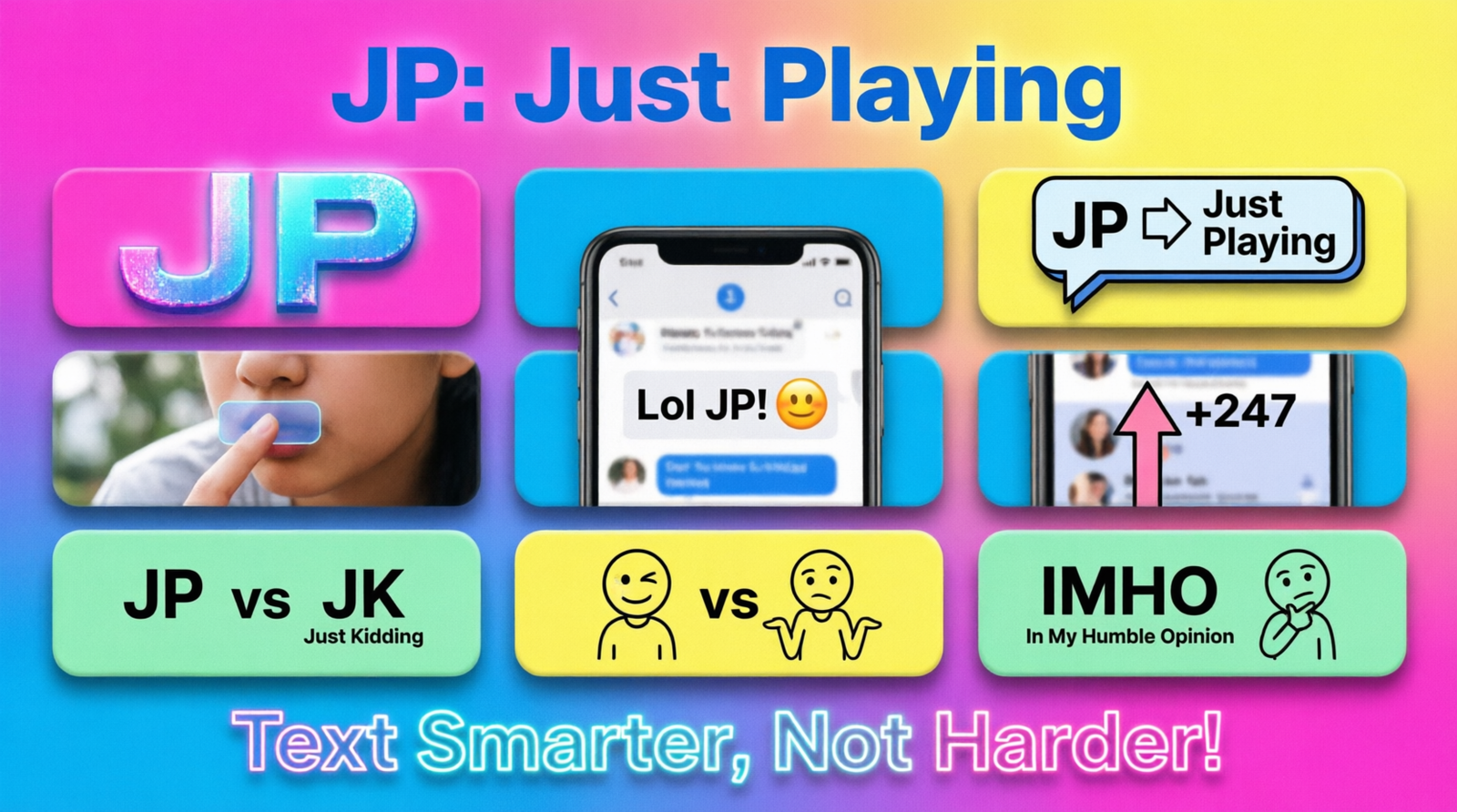
If someone sends you JP in a text they most commonly mean Just Playing. It usually tells you that the person was joking teasing, or not being serious. You may see it in casual texts DMs group chats Snapchat Instagram TikTok or gaming conversations.
The confusing part is that JP can mean different things in different situations. It may refer to Japan a person’s initials or a formal abbreviation such as Justice of the Peace. So, the message around it matters.
If you’re wondering what does JP mean in text this guide explains the most common meaning how people actually use it examples possible alternative meanings and how to respond naturally.
What Does JP Mean in Text?
In casual texting, JP usually means “Just Playing.”
When someone says “JP,” they are generally letting you know that something they just said was playful rather than serious. It can be used after a joke, tease, exaggerated statement, sarcastic comment, or fake complaint.
For example:
“You better buy me a new phone 😂 JP”
Here, JP means:
“I’m just playing.”
The person isn’t necessarily demanding a new phone. They are joking around.
Another example:
“I’m blocking you forever. JP 😂”
The first part sounds serious, but “JP” changes the tone. It tells the reader that the speaker is only joking.
This is why two letters can make a noticeable difference in a conversation. Without them, a teasing message might sound rude, angry, or overly serious.
Simple meaning of JP
JP = Just Playing
Depending on the situation, it can communicate:
- I’m just joking.
- I’m only teasing.
- I’m kidding around.
- I’m messing with you.
- I’m not being serious.
- Don’t take that literally.
Current slang references consistently describe “Just Playing” as the main texting use of JP, although they also point out that context can produce other meanings.
What Does “Just Playing” Mean?
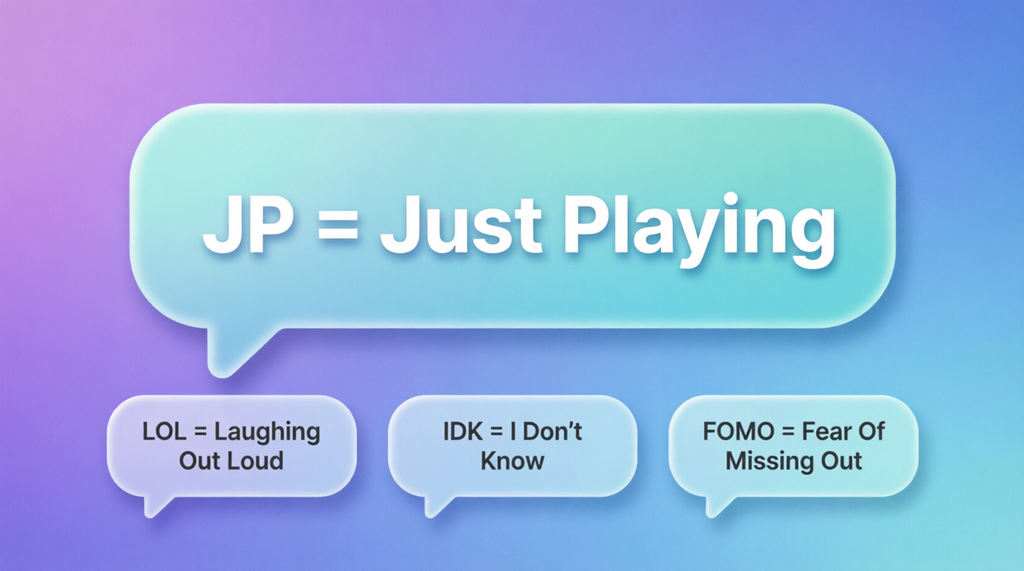
The phrase “just playing” means that someone is behaving or speaking in a playful way rather than making a serious statement.
Imagine your friend says:
“You owe me $500.”
You might immediately wonder what happened.
Then they add:
“JP 😂”
Now you understand that they were joking.
The abbreviation acts almost like a small tone marker. It gives you information about the speaker’s intention.
Text messages don’t have facial expressions, voice tone, or body language. Because of that, jokes can sometimes be misunderstood. A person might add “JP” to make their intention clearer.
This is especially useful when a message could otherwise sound harsh.
For example:
“You’re officially banned from my house. JP 😭”
The sender probably isn’t actually banning you. The exaggerated statement is part of the joke.
JP Meaning in a Text Message: Examples
The easiest way to understand slang is to see it in realistic conversations.
Example 1: Friendly teasing
Friend A: You are so dramatic.
Friend B: You’re one to talk 😂
Friend A: JP.
Here, “JP” means the person is just playing and isn’t trying to start an argument.
Example 2: Fake threat
Person A: I’m stealing your fries.
Person B: Touch them and we’re fighting.
Person A: JP 😂
The speaker is using JP to show that the comment was playful.
Example 3: Exaggeration
Friend A: I have to study for 12 hours tonight.
Friend B: That’s it. You’re officially a nerd now. JP 😭
The second speaker is teasing their friend rather than seriously insulting them.
Example 4: A playful complaint
Person A: You didn’t invite me?
Person B: I forgot 😭
Person A: Friendship over. JP lol.
The phrase makes the exaggerated “friendship over” comment sound playful.
Example 5: A joke about money
Friend A: You owe me dinner.
Friend B: Why?
Friend A: Because I said so.
Friend B: JP?
Friend A: Exactly 😂
The conversation makes it clear that the person is joking.
JP vs. JK: Are They the Same?
One of the most common questions about JP is whether it means the same thing as JK.
They are similar, but they come from different phrases.
| Abbreviation | Meaning | Typical use |
|---|---|---|
| JP | Just Playing | Playful teasing or joking |
| JK | Just Kidding | Clarifying that a statement was a joke |
| J/K | Just Kidding | Older-style version of JK |
| LOL | Laughing Out Loud | Shows amusement |
| Joking | Joking | Directly explains that something isn’t serious |
For example:
“You’re paying for everyone’s dinner. JP.”
and:
“You’re paying for everyone’s dinner. JK.”
Both communicate that the speaker isn’t serious.
However, “just playing” can have a slightly more playful or teasing feel, while “just kidding” is a more direct way to say that something was a joke.
There isn’t always a strict difference. People choose whichever expression fits their personal texting style.
Why Do People Use JP Instead of Writing the Full Phrase?
The main reason is convenience.
Texting encourages people to shorten familiar expressions. Instead of writing:
“I’m just playing with you.”
someone can simply write:
“JP 😂”
It’s quicker and takes less effort.
Short forms also fit naturally into fast-moving conversations. When friends are sending several messages in a row, nobody necessarily wants to type complete sentences every time.
This is part of the broader culture of internet communication. Abbreviations such as “LOL,” “BRB,” “IDK,” “TBH,” and “JK” have become familiar because they save time.
JP works in much the same way.
When Someone Says JP After an Insult
This is one situation where context becomes particularly important.
Suppose someone writes:
“You’re actually terrible at this. JP.”
They may simply be teasing you.
But consider:
“You’re worthless. JP.”
Adding “JP” doesn’t automatically make an insulting statement harmless.
People have different senses of humor, and not every joke feels funny to the person receiving it.
A person might use JP because they realize their comment could have sounded serious. Sometimes it is a genuine attempt to make a joke clear. Other times, someone may use it after saying something hurtful.
So don’t assume that “JP” automatically means there was no negative intention. Look at the entire conversation.
What Does JP Mean on Snapchat?
On Snapchat, JP can commonly be used in the same casual sense: “Just Playing.”
Snapchat conversations often move quickly, so short expressions fit naturally into the platform’s style.
For example:
“You’re never getting your hoodie back. JP 😂”
The person isn’t necessarily making a serious statement. They’re teasing.
You might also see it in a reply to a photo or video:
“Why do you always make that face? JP 😭”
Here, the abbreviation softens the comment.
However, JP isn’t a Snapchat-specific abbreviation. Its meaning depends on the conversation rather than the app itself.
What Does JP Mean on Instagram?
On Instagram, you might encounter JP in:
- Direct messages
- Comments
- Story replies
- Group conversations
- Casual captions
- Replies to Reels
For example:
“Delete this picture immediately 😂 JP”
The exaggerated request is probably playful.
Instagram comments can also be difficult to interpret because written humor doesn’t always show tone. Someone may add “JP” to make it obvious that a comment isn’t meant literally.
Still, not every appearance of “JP” on Instagram means “Just Playing.” A username, person’s initials, location, or other context may change the meaning.
What Does JP Mean on TikTok?
TikTok has its own fast-moving slang culture, and abbreviations can appear in comments, replies, captions, and DMs.
If someone comments:
“Never post again 😭 JP”
they’re probably joking rather than genuinely asking the creator to stop posting.
The surrounding words are important. TikTok users often exaggerate their reactions for humor, so JP may be added after an intentionally dramatic statement.
For example:
“I’m unfollowing you after this 😂 JP”
The statement is exaggerated for comedic effect.
But if “JP” appears next to a topic involving Japan, Japanese culture, travel, or a person’s initials, another meaning may be more appropriate.
What Does JP Mean in Gaming?
Gaming conversations can make abbreviations particularly confusing because players use specialized vocabulary.
In a casual gaming chat, JP can still mean “Just Playing.”
For example:
“Bro I could beat you with one hand. JP 😂”
The player is teasing their friend.
But gaming communities can also have their own abbreviations and terminology. Therefore, you shouldn’t automatically interpret every “JP” as “Just Playing.”
Look at what the players were discussing immediately before the abbreviation appeared.
If the conversation is about a person, server, location, game mode, or technical feature, JP may have another meaning.
Can JP Mean Japan?
Yes.
JP is also widely associated with Japan, especially in international, travel, geographic, technical, and web-related contexts.
For example:
“I’m visiting JP next summer.”
Here, JP could mean Japan, not “Just Playing.”
Another example:
“This product is only available in JP.”
In this context, “JP” is much more likely to refer to Japan.
The .jp country-code top-level domain is also associated with Japan.
This is an important distinction because context can completely change the interpretation.
Compare these:
“You’re so annoying, JP 😂”
Likely: Just Playing
versus:
“The JP server has better players.”
Likely: Japan or a Japan-related server.
The surrounding words make the intended meaning much easier to identify.
Can JP Be Someone’s Initials?
Absolutely.
A person named James Parker, for example, might be referred to as “JP.”
In that case, JP isn’t slang at all.
Consider:
“JP said he’ll meet us at 8.”
This sounds like someone is talking about a person named JP.
If you responded, “What does ‘just playing’ mean here?” you would probably misunderstand the message.
This is why looking at the grammatical role of the abbreviation can help.
If JP appears after a joke, “Just Playing” may make sense.
If JP appears as the subject of a sentence, it could be someone’s initials.
For example:
“JP is coming over later.”
That’s very different from:
“I’m joking, JP.”
Can JP Mean Justice of the Peace?
Yes.
In formal or legal contexts, JP can stand for “Justice of the Peace.”
This is not internet slang.
A Justice of the Peace is a legal or judicial office in various jurisdictions, although the exact duties and authority vary by location.
For example, you could encounter “JP” in legal, governmental, or official documents.
So if you see:
“The document must be witnessed by a JP.”
you shouldn’t interpret JP as “Just Playing.”
The subject matter clearly points toward the formal meaning.
This is a good reminder that abbreviations don’t have one universal definition.
Other Possible Meanings of JP
Although “Just Playing” is the main casual texting interpretation, JP can represent many other things.
Depending on the context, it may refer to:
- Just Playing — casual texting and online slang
- Japan — geographic or international context
- Justice of the Peace — legal or official context
- A person’s initials — names such as James Parker
- Job Posting — some workplace or recruitment contexts
- A company, organization, project, game term, or community-specific abbreviation
Not all of these meanings are equally common in everyday texting.
The important lesson is simple: don’t interpret two letters without reading the surrounding message.
How to Tell Which JP Meaning Someone Intended
You can usually figure it out by looking at five clues.
1. Look at the sentence before JP
If someone says:
“I’m taking your last cookie. JP 😂”
“Just Playing” is an obvious fit.
If they say:
“The JP website has different prices.”
Japan is more likely.
2. Look at the topic
Ask yourself what the conversation is about.
If you’re talking about:
- jokes
- friends
- teasing
- relationships
- memes
- social media
then “Just Playing” is plausible.
If you’re talking about:
- travel
- countries
- Japanese products
- legal documents
- work
- a specific person
another meaning may make more sense.
3. Look at punctuation and emojis
An abbreviation like:
“JP 😂”
strongly suggests a playful context.
Likewise:
“JP 😭”
may be attached to a humorous or exaggerated statement.
Emojis don’t determine meaning by themselves, but they can provide useful clues about tone.
4. Consider who sent it
If a close friend sends “JP” after teasing you, “Just Playing” is a reasonable interpretation.
If a coworker sends “JP” while discussing a job application, the same letters could mean something completely different.
5. Read the entire message
Never focus only on the abbreviation.
For example:
“JP is arriving tomorrow.”
and:
“I’m kidding, JP 😂”
contain the same letters but obviously don’t use them in the same way.
Is JP a Romantic Slang Term?
Not necessarily.
JP does not inherently mean anything romantic or sexual.
If someone sends:
“I miss you. JP 😂”
the context could suggest flirting, but the abbreviation itself doesn’t create a romantic meaning.
Likewise, if someone says:
“You’re cute. JP.”
they might be teasing you, taking back the compliment, or trying to make the situation less awkward.
The relationship between the people matters more than the abbreviation.
So if you’re trying to figure out whether someone is flirting, don’t rely on “JP” alone. Look at the broader conversation and how that person normally communicates with you.
Is JP Rude?
Usually, JP is not rude.
It is generally a casual and playful expression.
However, the statement that comes before it can still be offensive.
For example:
“You’re so annoying. JP.”
could be harmless teasing between close friends.
But if the same sentence comes from someone you barely know, it could feel insulting.
Similarly, using “JP” after a sensitive comment doesn’t automatically erase the impact of what was said.
Good communication still depends on tone, relationship, timing, and subject matter.
How Should You Reply When Someone Says JP?
Your response depends on what they said before “JP.”
If you understand that they’re joking, you can respond playfully.
For example:
“Lol, I knew you were joking 😂”
Or:
“You almost had me there.”
You could also tease them back:
“Nice try 😂”
If you’re genuinely unsure what they meant, simply ask:
“JP meaning just playing?”
There’s nothing wrong with asking.
In fact, asking is usually better than confidently responding to the wrong interpretation.
Casual replies
Here are some natural responses:
- “Lol 😂”
- “I knew it.”
- “You got me for a second.”
- “Haha, okay.”
- “Nice one 😂”
- “I almost believed you.”
- “Sure you were 😭”
Your reply should match the relationship and the tone of the original message.
When Should You Use JP?
JP is best suited to informal conversations.
You might use it with:
- Friends
- Family members who understand texting slang
- Gaming friends
- Social media contacts
- People you regularly message casually
For example:
“You’re buying pizza for everyone tonight. JP 😂”
That’s perfectly natural in a friendly conversation.
When Should You Avoid JP?
Avoid relying on JP when the conversation is formal or potentially sensitive.
For example, don’t use it in an important business email like:
“I didn’t finish the report. JP.”
That could create confusion rather than humor.
It’s also better to avoid abbreviations when you’re communicating about serious issues, complaints, instructions, legal matters, or professional responsibilities.
In those situations, clear language is more useful than slang.
Instead of:
“JP”
you can simply write:
“I’m joking.”
That removes ambiguity.
JP in Lowercase vs. Uppercase
You may see JP, jp, or occasionally Jp.
In casual messaging, capitalization usually doesn’t change the meaning.
For example:
“jp 😂”
and:
“JP 😂”
can both mean “Just Playing.”
People often type abbreviations in lowercase because they’re texting quickly.
However, capitalization can sometimes provide clues in other contexts. For instance, JP as a person’s initials or a formal abbreviation may naturally be capitalized.
Still, capitalization alone isn’t enough to determine the meaning.
Why Two-Letter Slang Can Be Confusing
Internet slang is built around speed and shared understanding.
The problem is that short forms remove information.
When someone writes “Just Playing,” you know exactly what they mean.
When they write “JP,” you have to interpret the abbreviation using context.
That’s why someone unfamiliar with the expression might wonder:
“Does JP mean just playing, Japan, someone’s name, or something else?”
There isn’t always a universal answer.
The same abbreviation can have completely different meanings in different communities.
This is especially true online, where people from different countries, age groups, workplaces, and interests communicate in the same spaces.
JP Meaning in Different Situations
Here’s a quick comparison:
| Situation | Likely meaning of JP |
|---|---|
| Friend makes a joke | Just Playing |
| Someone teases you | Just Playing |
| Snapchat conversation | Usually Just Playing |
| Instagram DM | Often Just Playing |
| TikTok comment | Often Just Playing |
| Travel discussion | Japan |
| Japanese product discussion | Japan/Japanese context |
| Legal document | Justice of the Peace |
| Conversation about a person’s name | Initials |
| Recruitment conversation | Possibly Job Posting |
| Gaming | Depends on the game’s context |
The table isn’t a rulebook. It is simply a guide to help you identify the most likely interpretation.
Common Mistakes People Make With JP
Mistake 1: Assuming it always means “Just Playing”
This is the biggest mistake.
While that is a common texting meaning, context can point elsewhere.
Mistake 2: Treating JP like a universal abbreviation
Not everyone knows every piece of internet slang.
Someone may genuinely not understand what you mean.
Mistake 3: Using JP after a serious statement
If you’re discussing something important, “JP” can make your message confusing or insensitive.
Mistake 4: Ignoring the surrounding words
The abbreviation itself isn’t enough.
Always read the sentence before and after it.
Mistake 5: Assuming it means flirting
JP doesn’t automatically indicate romantic interest.
The relationship and broader conversation matter more.
Is JP Still Used in 2026?
Yes, you can still encounter JP as a casual abbreviation online, particularly in informal conversations. However, slang usage is not uniform, and different communities may prefer other expressions such as “JK,” “lol,” “just kidding,” or simply “I’m joking.” Current online references continue to identify “Just Playing” as a common texting interpretation.
Like many internet abbreviations, its popularity can vary from person to person.
Someone may use JP frequently, while another person may never use it at all.
That doesn’t necessarily mean one person is using it incorrectly. Online language is flexible.
JP vs. “Just Kidding”
Although JP and JK are similar, there’s a small difference in feel.
Just Playing can suggest that you’re playfully messing with someone.
Just Kidding more directly says that what you said wasn’t serious.
Compare:
“You have to wash my car tomorrow. JP 😂”
This feels like playful teasing.
Now:
“I hate your new haircut. JK!”
This more directly takes back the previous statement.
In everyday conversation, though, the two can overlap considerably.
Frequently Asked Questions About JP
What does JP mean in text?
In casual texting, JP most commonly means “Just Playing.” It tells someone that the previous statement was intended as a joke, tease, or playful comment.
What does JP mean on Snapchat?
On Snapchat, JP can mean “Just Playing” when it appears after a joke or teasing message. However, context still matters.
What does JP mean on TikTok?
On TikTok, JP may be used in comments, replies, or DMs to show that an exaggerated or teasing statement wasn’t serious.
Is JP the same as JK?
They’re similar. JP means “Just Playing,” while JK means “Just Kidding.” Both can be used to show that a statement was meant humorously.
Can JP mean Japan?
Yes. In travel, geographic, or Japanese-related contexts, JP can refer to Japan.
Can JP be a person’s initials?
Yes. Someone may use JP as initials, such as for a person’s first and last name.
Does JP mean “Just Playing” everywhere?
No. “Just Playing” is a common casual texting meaning, but abbreviations depend on context.
Is JP formal?
No. When JP means “Just Playing,” it is informal internet slang. It is generally better suited to casual conversations than professional writing.
Is JP rude?
Not normally. It is generally playful, but the words surrounding it can still be rude or offensive.
What should I say if someone texts JP?
If you understand the joke, you can reply naturally with something like “Lol, I knew you were joking 😂” or “You almost got me.” If you’re unsure, ask what they mean.
Final Takeaway:
So what does JP mean in text?
In most casual texting situations JP means Just Playing. It is a short way to tell someone that you were joking teasing exaggerating or simply not being serious
For example:
I’m taking your last slice of pizza. JP
means:
I’m just playing. I’m joking.
The key is context. If JP appears after a playful comment Just Playing is probably the intended meaning. But if the conversation is about Japan, a legal matter, a person’s initials work or another specialized topic JP may mean something entirely different.
When in doubt, read the whole message before deciding what the abbreviation means.
The easiest rule to remember is:
JP Just Playing in casual text,but context decides the meaning.
That small distinction can save you from misunderstanding a message and help you sound more natural when using internet slang yourself.
Discover more post:
| https://textglossary.com/lkr-mean-in-text/ |
| https://textglossary.com/what-does-hhhhh-mean-in-text/ |
| https://textglossary.com/what-does-ttys-mean-in-a-text/ |

Zeya is a passionate English language writer and content creator with over 5 years of experience in writing about words, slang, abbreviations, texting language, expressions, and everyday communication .As an author at TextGlossary, Zeya specializes in turning confusing words, internet slang, acronyms, and modern expressions into simple, clear, and easy-to-understand explanations. Her goal is to help readers quickly understand what a word or phrase means, how it is used, and what it means in real conversations.
Comments