
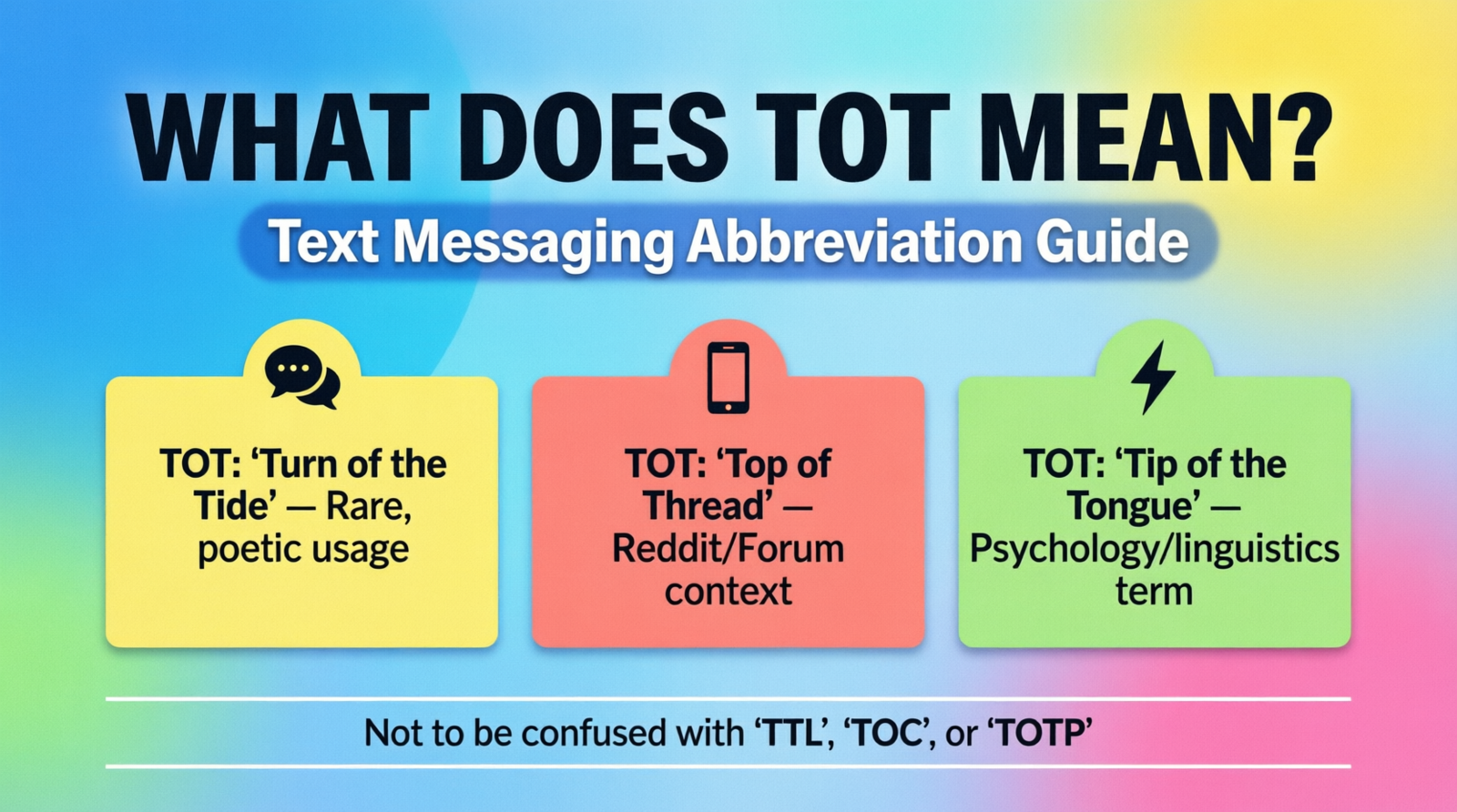
If someone sent you tot in a text and you were left wondering what they meant you are not alone. In texting and online conversations tot can have different meanings depending on the context.
It may be a shortened form of totally refer to a small child or appear as an abbreviation in a particular community.
The most important thing is the sentence around it. Internet slang is often flexible and people do not always use abbreviations in exactly the same way.
So, what does tot mean in text slang? In many casual conversations tot can mean totally especially when someone wants to agree strongly or emphasize something.
However tot also has an established English meaning: a small child or young person. Understanding the surrounding message will usually tell you which meaning applies.
This guide explains the different meanings of tot how people use it in texting and social media and how to respond when you are unsure.
What Does “Tot” Mean in Text Slang?
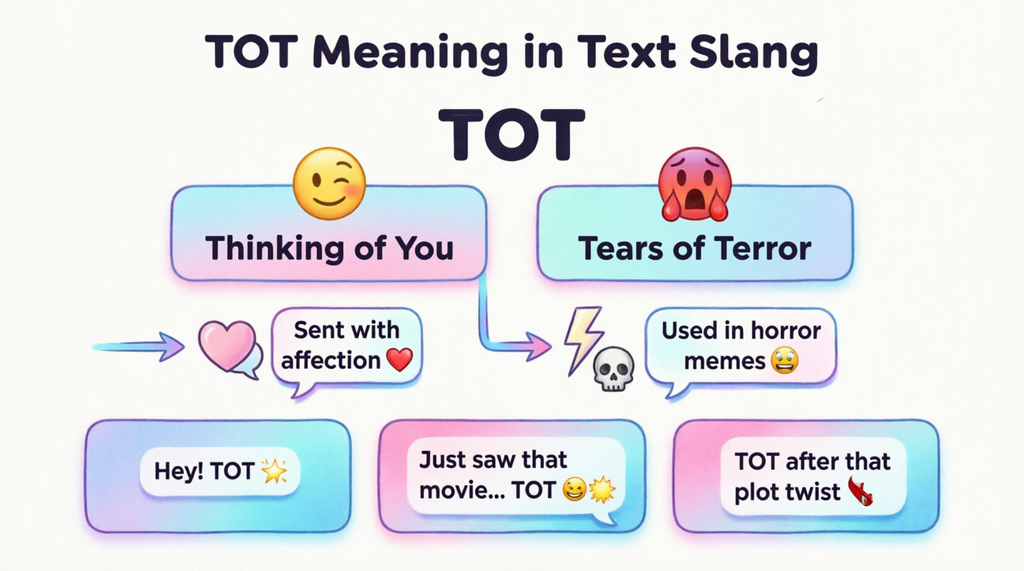
When used as texting slang, “tot” can be a shortened version of “totally.”
For example:
“That movie was tot amazing.”
Here, “tot” is being used informally to mean “totally.”
Another example might be:
“I tot agree with you.”
In this sentence, the person means:
“I totally agree with you.”
This type of shortening is common in informal digital communication. People often remove letters from longer words because texting is fast and conversational.
However, “tot” is not universally understood as “totally.” Unlike highly standardized abbreviations such as “LOL” or “BRB,” its meaning can depend heavily on the person using it.
That is why context matters.
The Common Meanings of “Tot”
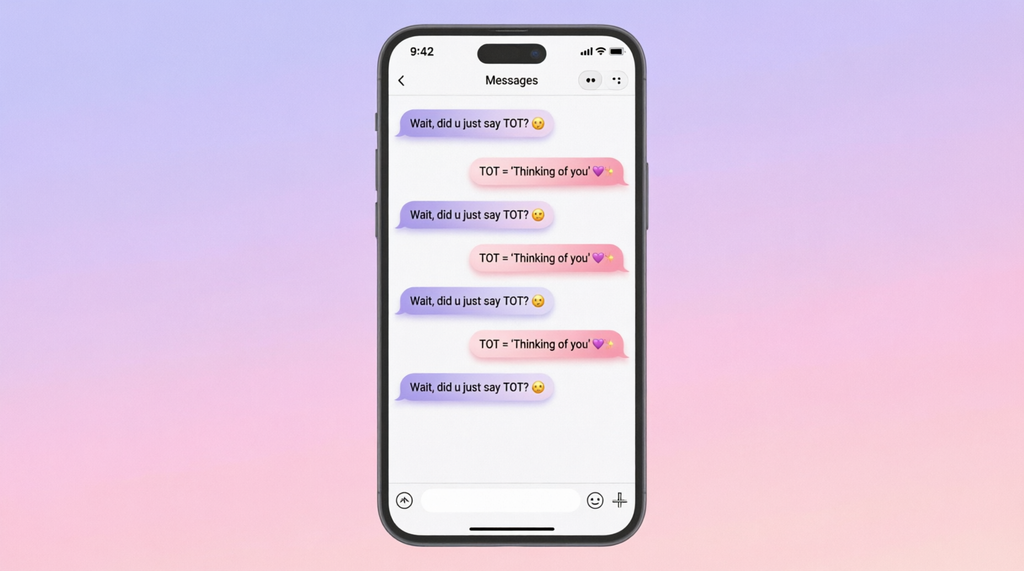
The word “tot” can refer to several things. Before assuming it is slang, consider the most likely meanings.
1. “Tot” Can Mean “Totally”
In informal texting, some people use “tot” as a shortened form of “totally.”
Examples include:
- “I tot forgot.”
- “That is tot true.”
- “I tot understand.”
- “You’re tot right.”
- “I tot agree.”
In each case, the intended word is likely “totally.”
This usage is casual rather than formal. You would generally not use it in a school essay, business email, job application, or professional report.
2. “Tot” Can Mean a Small Child
“Tot” is also a normal English word meaning a young child or little kid.
For example:
“The playground is designed for tots.”
Here, “tot” has nothing to do with texting slang.
Someone might also write:
“My little tot is finally walking.”
Again, the word means a small child.
This meaning is especially important because it predates modern texting culture. “Tot” is not simply an internet abbreviation.
3. “Tot” Can Be Used as a Verb
In some contexts, particularly in the expression “tot up,” the word means to add numbers together or calculate a total.
For example:
“Can you tot up the expenses?”
This is a different meaning from both “totally” and “small child.”
It is much less likely to appear in casual texting between friends, but it can occur in ordinary written English.
4. “TOT” Can Be an Acronym
When written in uppercase as TOT, the letters may represent an acronym rather than slang.
The exact meaning can change depending on the subject.
For instance, a particular school, workplace, gaming group, technical community, or organization may use TOT to represent something specific.
This is why seeing capital letters does not automatically tell you what the sender intended.
Why Do People Use “Tot” in Text Messages?
Texting encourages people to communicate quickly. Instead of writing complete words, users often shorten them.
You may already be familiar with forms such as:
- “u” for “you”
- “bc” for “because”
- “idk” for “I don’t know”
- “rn” for “right now”
- “tbh” for “to be honest”
- “omw” for “on my way”
A shortened form such as “tot” can work in the same general environment.
People may use it because it is quicker to type, fits their personal texting style, or feels more casual.
Sometimes, however, the shortening is simply a typo or personal habit. Not every unusual word is an established slang term.
Examples of “Tot” Meaning “Totally”
Context is the easiest way to understand this usage.
Example 1
Person A: “Are you coming tonight?”
Person B: “Tot! I’ll be there at 8.”
Here, “tot” may be intended as an abbreviated “totally,” although “definitely” or “sure” might be more natural depending on the person’s style.
Example 2
Person A: “Do you agree with her?”
Person B: “I tot agree.”
The intended meaning is likely:
“I totally agree.”
Example 3
Person A: “Was the concert good?”
Person B: “Tot worth it.”
The person likely means:
“Totally worth it.”
Example 4
Person A: “You were right about that show.”
Person B: “Tot!”
In this very short exchange, the abbreviation may be used as an emphatic agreement.
Still, because “tot” is not a universally standardized abbreviation for “totally,” you should consider the sender’s usual texting habits.
Examples of “Tot” Meaning a Child
Now compare those examples with situations involving children.
Example 1
“The tot was playing with her toy.”
Here, “tot” means a young child.
Example 2
“There were several tots at the birthday party.”
Again, the meaning is clearly young children.
Example 3
“This class is suitable for toddlers and tots.”
The surrounding words make the meaning obvious.
Example 4
“He has a cute little tot at home.”
In this context, there is no reason to interpret “tot” as “totally.”
How Context Changes the Meaning
The same three letters can mean different things in different messages.
Consider this:
“I tot agree.”
The likely meaning is “I totally agree.”
Now consider:
“The tot is sleeping.”
The likely meaning is “The small child is sleeping.”
The spelling has not changed, but the context has.
This is one of the biggest challenges with internet slang. Abbreviations are often informal and lack fixed rules.
When you encounter an unfamiliar term, look at:
- The words before and after it.
- The subject of the conversation.
- The sender’s usual writing style.
- Whether the word is lowercase or uppercase.
- Whether replacing it with a longer word makes the sentence logical.
These clues can usually solve the mystery.
Is “Tot” Actually Slang?
It can be, but not every use of “tot” is slang.
The word has a legitimate dictionary meaning referring to a small child. When someone uses it as a shortened version of “totally,” the usage becomes informal and slang-like.
That distinction is useful.
For example:
“The tot was tired.”
This is ordinary English.
But:
“I tot love this.”
This is informal texting language.
So, when searching for the meaning of “tot” in a text message, it is better to think of it as a context-dependent abbreviation or informal expression, rather than assuming it has one official slang definition.
“Tot” vs. “Totally”
The biggest difference is formality and completeness.
Totally is the standard word.
Tot is a shortened informal form that some people may use in digital communication.
Compare:
| Form | Meaning | Typical use |
|---|---|---|
| Totally | Completely; absolutely | Standard English |
| Tot | May mean “totally” in informal texting | Casual messages |
| Tot | Small child | Ordinary English |
If you are writing something important, use “totally” instead of “tot.”
For example, write:
“I totally agree with your point.”
rather than:
“I tot agree with your point.”
The first version is clearer and appropriate in both casual and professional settings.
Does “Tot” Mean the Same Thing on Social Media?
Not necessarily.
Social media platforms do not have a single universal slang dictionary. A word can develop different meanings within different groups.
On TikTok, Instagram, Snapchat, Discord, Reddit, or messaging apps, people may use “tot” differently.
One person might use it as a shorthand for “totally.”
Another might use “tot” in its normal sense of a young child.
Someone else may use TOT as an acronym connected to a particular interest or community.
Therefore, the platform alone is not enough to determine the meaning.
The actual message is more useful than the app where you saw it.
What Does “Tot” Mean on TikTok?
If you encounter “tot” on TikTok, do not automatically assume it has one fixed TikTok-specific meaning.
TikTok slang changes quickly, and users often create or popularize new expressions. A term can also be part of a niche community’s vocabulary.
If “tot” appears in a sentence such as:
“I tot agree with this.”
it probably functions as an informal shortening of “totally.”
But if you see:
“Look at that tot!”
the normal meaning of “small child” may be intended.
Comments can be especially difficult to interpret because users frequently omit punctuation and write in fragments.
What Does “Tot” Mean on Snapchat?
Snapchat conversations are usually casual and fast-moving, so abbreviations are common.
If someone sends:
“Tot 😂”
they may be using it as an informal agreement or shortened expression.
However, a single-word message can be ambiguous.
If you are unsure, asking a quick question is often easier than guessing.
You could simply say:
“What do you mean by tot?”
There is nothing strange about asking. Slang differs from person to person, and even experienced internet users occasionally encounter unfamiliar abbreviations.
What Does “Tot” Mean on Instagram?
On Instagram, “tot” may appear in captions, comments, direct messages, or replies.
The meaning depends on the content.
For example:
“I tot need this outfit.”
Here, “tot” may be intended to mean “totally.”
But:
“Such a cute tot!”
probably refers to a child.
Instagram comments often rely on short phrases, emojis, and conversational language, which can make context especially important.
What Does “Tot” Mean in Texting Between Friends?
Among friends, people are more likely to experiment with spelling and abbreviations.
A close friend might write:
“I tot forgot about that 😭”
The intended meaning is probably:
“I totally forgot about that.”
Because friends already understand each other’s communication style, unusual abbreviations are less likely to cause confusion.
Someone may also intentionally shorten a word because they want the message to sound playful.
For example:
“You’re tot crazy 😂”
The abbreviation adds a casual tone rather than changing the basic meaning.
Could “Tot” Be a Typo?
Yes.
This is an important possibility that is often overlooked.
Someone might intend to type:
- “got”
- “not”
- “too”
- “totally”
- another word entirely
and accidentally produce “tot.”
Mobile keyboards make typos common, especially when people type quickly.
If the sentence does not make sense when “tot” is interpreted as “totally” or “small child,” a typo may be the simplest explanation.
Do not force a slang definition onto a message that may simply contain a spelling mistake.
How to Tell Which Meaning Is Intended
When you receive “tot,” use a simple context check.
Step 1: Read the entire sentence
Do not interpret the abbreviation by itself.
For example:
“I tot love it.”
is very different from:
“The tot loves it.”
The surrounding grammar provides a strong clue.
Step 2: Replace “tot” with “totally”
If the sentence suddenly makes sense, the abbreviation may mean “totally.”
For example:
“I tot agree.”
becomes:
“I totally agree.”
That works naturally.
Step 3: Try the child meaning
Ask whether “small child” makes sense.
“The tot is eating.”
Yes, that works.
“I tot agree.”
No, the child meaning does not work.
Step 4: Consider the conversation topic
If you were discussing parenting, children, daycare, or a family event, “tot” may refer to a child.
If you were discussing an opinion, movie, outfit, game, or experience, the “totally” interpretation may be more likely.
Step 5: Consider the person’s writing habits
Some people use unusual abbreviations frequently.
If a friend often shortens words, you can use their previous messages as a clue.
Is “Tot” Rude or Offensive?
Generally, “tot” is not inherently rude or offensive.
When it means “totally,” it is simply informal.
When it refers to a child, it is usually a neutral or affectionate word.
That said, tone always matters.
Calling someone a “tot” when they are an adult could sound childish or patronizing depending on the context. Likewise, using unfamiliar abbreviations in a serious conversation can create confusion.
The word itself is not normally offensive, but how it is used can affect how the message feels.
Can You Use “Tot” in Formal Writing?
It is better not to use the abbreviation “tot” for “totally” in formal writing.
Avoid it in:
- Academic assignments
- Professional emails
- Job applications
- Business reports
- Official documents
- Customer-service communication
- Formal presentations
Instead, write the complete word.
Use:
“I totally understand your concern.”
rather than:
“I tot understand your concern.”
The full form is clearer and immediately understood by a wider audience.
The noun “tot,” meaning a young child, is perfectly acceptable in ordinary writing when that meaning is appropriate.
Is “Tot” the Same as “Totes”?
Not exactly.
“Totes” is another informal shortening associated with “totally.”
For example:
“Totes agree!”
means approximately:
“Totally agree!”
“Totes” became popular as playful internet and conversational slang.
“Tot” can sometimes serve a similar purpose, but the two forms are not identical and should not automatically be treated as interchangeable.
If someone writes “totes,” the intended meaning is usually much easier to recognize because it has a stronger association with “totally.”
“Tot” vs. Other Texting Abbreviations
It helps to compare it with more widely recognized slang.
| Slang | Meaning | Commonness |
|---|---|---|
| LOL | Laughing out loud | Very common |
| IDK | I don’t know | Very common |
| TBH | To be honest | Common |
| BTW | By the way | Common |
| RN | Right now | Common |
| TTYL | Talk to you later | Common |
| Tot | Possibly “totally” or a small child | Context-dependent |
The key difference is that “tot” has multiple established meanings.
Someone unfamiliar with the sender’s style may therefore need more context.
Why Slang Meanings Are Sometimes Hard to Find
Internet slang does not develop through one official organization.
People invent abbreviations in group chats, gaming communities, social media comments, fandoms, and online forums. Some become popular. Others disappear quickly.
That means a slang term can have:
- Multiple meanings
- Regional meanings
- Community-specific meanings
- Older dictionary meanings
- Newer internet meanings
- Different interpretations among age groups
This is why a search result giving one definition should not always be treated as the final answer.
For “tot,” context is particularly important because the word already exists in standard English.
Common Sentences Using “Tot”
Here are some examples showing how the meaning can change.
Informal “Totally”
“I tot forgot to call you.”
Meaning: I totally forgot to call you.
“That was tot unexpected.”
Meaning: That was totally unexpected.
“You’re tot right.”
Meaning: You’re totally right.
“I tot love this song.”
Meaning: I totally love this song.
“Small Child”
“The tot was running around the garden.”
Meaning: The young child was running around the garden.
“The restaurant has a menu for tots.”
Meaning: The restaurant has a menu for young children.
“Several tots were playing nearby.”
Meaning: Several small children were playing nearby.
What If Someone Texts Just “Tot”?
A one-word message is harder to interpret.
Suppose you say:
“I think we should go.”
They reply:
“Tot.”
There are several possibilities.
They may mean:
- “Totally.”
- “Absolutely.”
- “I agree.”
But there is not enough information to guarantee the interpretation.
Their normal communication style becomes important.
If they frequently use “tot” as an abbreviation, you can probably understand it as an informal agreement.
If they rarely use slang, it could even be a typo.
What Should You Reply to “Tot”?
If the intended meaning is clearly “totally,” you can simply continue the conversation.
For example:
Them: “Tot!”
You: “Haha, glad you agree.”
If you are unsure, ask naturally:
“Totally? 😄”
This can work as both a clarification and a continuation of the conversation.
Or simply ask:
“What does ‘tot’ mean here?”
There is no need to overthink an abbreviation when the sender can explain it in seconds.
Does Capitalization Change the Meaning?
Sometimes it can.
Lowercase “tot” is more likely to appear as an ordinary word or informal abbreviation.
Uppercase “TOT” may indicate an acronym.
For example:
“TOT”
could represent a phrase made from three initial letters.
However, capitalization is not a reliable rule. Many people type entire messages in lowercase, while others capitalize abbreviations randomly.
Treat capitalization as one clue rather than a definite answer.
Does “Tot” Have a Different Meaning in Gaming?
Potentially.
Gaming communities often create their own abbreviations, and a three-letter combination may represent a game-specific term, player role, feature, strategy, or phrase.
If you see “TOT” repeatedly in a gaming discussion, look at the surrounding terminology.
For example, if the conversation includes game statistics, player ratings, equipment, or a specific title, the abbreviation may belong to that game’s vocabulary rather than general texting slang.
Do not assume every three-letter abbreviation is general internet slang.
Does “Tot” Have a Different Meaning in Different Countries?
It can.
English vocabulary varies between countries, and words that sound informal in one place may be more familiar in another.
“Tot” as a word for a small child is recognized in several varieties of English, while informal abbreviations can spread through different online communities at different speeds.
Texting habits also vary by age and region.
Therefore, if someone from another country uses “tot,” their intended meaning may not match the meaning you normally associate with it.
Why Short Words Can Have So Many Meanings Online
Digital communication removes many clues that are available in face-to-face conversation.
When speaking, you can hear:
- Tone of voice
- Stress
- Pauses
- Emotion
- Sarcasm
- Hesitation
A text message does not always provide those clues.
That is why people use emojis, punctuation, capitalization, repeated letters, and slang to communicate tone.
A short abbreviation such as “tot” can therefore depend heavily on context.
The surrounding conversation fills in the missing information.
Common Mistakes When Interpreting “Tot”
There are a few easy mistakes to avoid.
Mistake 1: Assuming There Is Only One Definition
There is no single interpretation that works for every message.
Mistake 2: Treating Every Use as Slang
Sometimes “tot” simply means a young child.
Mistake 3: Ignoring the Rest of the Message
The sentence often provides the strongest clue.
Mistake 4: Assuming Social Media Creates the Meaning
A word may have existed long before modern social platforms.
Mistake 5: Overthinking a Typo
Sometimes “tot” is simply a typing mistake.
Frequently Asked Questions
What does “tot” mean in text slang?
In some informal text messages, “tot” can be used as a shortened form of “totally.” However, it can also mean a small child, which is a standard English meaning. Context determines the intended meaning.
Is “tot” short for “totally”?
It can be. Some people use “tot” informally as a shortened form of “totally,” although this is not a universal texting abbreviation.
What does “tot” mean from a girl?
It does not have a special meaning simply because a girl uses it. The meaning depends on the sentence and conversation.
What does “tot” mean from a guy?
The same rule applies. A male sender may use “tot” to mean “totally,” refer to a child, use an acronym, or simply make a typo.
Does “tot” mean “totally”?
Sometimes, especially in informal texting. But it is not safe to assume that every occurrence means “totally.”
Is “tot” a real English word?
Yes. “Tot” is a real English word commonly used to describe a small child. It can also appear in the phrase “tot up,” meaning to add or calculate a total.
Is “tot” a Gen Z slang word?
Not necessarily. The word itself is older than modern Gen Z internet culture. Its use as an informal abbreviation may appear in digital communication, but that does not make every use uniquely Gen Z.
Is “tot” the same as “totes”?
No. “Totes” is a playful abbreviation commonly associated with “totally.” “Tot” can sometimes have the same intended meaning in texting, but it also has other meanings.
What should I do if I don’t understand “tot”?
Read the full sentence and consider the conversation topic. If the meaning is still unclear simply ask the sender what they meant.
Final Takeaway:
So what does tot mean in text slang? The answer depends on context. In informal digital conversation some people use tot as a shortened form of totally. But tot is also a standard English word for a small child, and uppercase TO” can represent an acronym in a particular community.
The safest way to interpret it is to look at the sentence rather than the abbreviation alone.
If someone writes I tot agree they probably mean I totally agree. If they write The tot is sleeping they are almost certainly talking about a young child
And if neither interpretation makes sense do not assume there is some complicated secret slang meaning. It may simply be a typo or a personal abbreviation.
Internet language changes constantly but context remains the best tool for understanding it.
Discover more post:
| https://textglossary.com/lkr-mean-in-text/ |
| https://textglossary.com/what-does-hhhhh-mean-in-text/ |
| https://textglossary.com/what-does-ttys-mean-in-a-text/ |

Aria is a passionate writer, language enthusiast, and content creator with over 5 years of experience researching and explaining words, phrases, slang, abbreviations, expressions, and modern language trends. As an author at TextGlossary, she is dedicated to making confusing words and everyday expressions simple, clear, and easy to understand.
Comments